you can’t fake what you haven’t faced

subscribe on
When you think about public speaking, do you think about delivery: clear pronunciation, confident posture, maybe even the perfect script? What if the real issue isn't technical at all? What if the way you speak is just the surface of something deeper?
In this week’s episode of The Foreign Accent Stamp, I explore something that’s rarely talked about in traditional public speaking training: why personal development is the hidden force behind your vocal confidence, your clarity, and your presence. Let's explore why personal development is the missing piece in your speaking strategy:
Most people think public speaking is just about skill. About voice. About technique. But if you’ve ever stood in front of a room, feeling like your legs might give out while your perfectly prepared words evaporate from memory—you know there’s more to it.
speaking is not just skill—it’s self
You can sound polished. You can practice for hours. And still, when it’s time to deliver, something feels off. You feel shaky. You rush. You over-correct. You tense up. Why? Because your nervous system doesn’t care how polished your script is. It cares how safe you feel. And your voice will always reflect that.
You can master every script, every pronunciation guide, every storytelling formula. But when the time comes to speak, your voice still trembles. You rush. You freeze. Why? Because you can’t fake what you haven’t faced. Public speaking is more than just a performance—it’s an act of visibility and vulnerability. It’s the moment you choose to be seen. Fully. In a foreign language. And that doesn’t just require skill. It requires self-trust. The one that starts before the mic.
The truth is: confidence doesn’t start on stage. It starts long before—with the inner work. The quiet work. The kind that asks: who am I to be seen? Who am I to take up space? What if I’m judged for how I sound? What if I’m not ready? These aren’t “speech issues.” They’re personal development challenges that show up in your voice.
what personal development really means in this context
I’m not talking about confidence affirmations or journaling prompts (though those can help too). I’m talking about examining your beliefs:
Who are you to speak up?
Who are you to be heard?
Who are you to take the stage?
These silent questions shape everything about how you sound. They show up in your pitch, your pacing, your projection. They show up in how much space you allow yourself to take—vocally and physically.
Your voice reflects your inner state. What’s going on internally always makes its way out. Anxiety can show up as rushed speech or vocal tension. Insecurity might flatten your tone or weaken your volume. Perfectionism can create stiffness or make you overcorrect every sound. Even your pronunciation improves when your nervous system is calm.
accent work is about identity, not just sound
A lot of the people I work with aren’t just trying to sound more “native.” They’re trying to sound more like the version of themselves they know they can be - they know they are. The version that’s articulate and confident in their mother tongue—but who feels muted in English. And often, the real block isn’t technical. It’s emotional. It’s the fear of being judged, the hesitation to take up space, the belief that your foreign accent makes you “less than.” These aren’t voice problems. They’re personal development challenges masquerading as speech issues.
Your body is your instrument—and when it’s tense, your voice suffers. Yes, pronunciation matters. But clarity comes from mental and physical alignment. Clarity is emotional, not just technical. It’s not about sounding perfect. It’s about sounding like you—the version of yourself you know you are in your first language, but haven’t yet unlocked in English. And the fastest way to unlock it? Work on what’s underneath.
You don’t need to feel 100% confident. But you do need to feel congruent. When your mindset and your message are aligned, your voice naturally becomes more powerful. When your inner world aligns with your outer delivery, people feel it. Your message lands with ease. Your voice flows with clarity. Your pacing steadies. Your articulation softens. You speak from a grounded place. Even accent reduction becomes easier—because your body is no longer in fight-or-flight. And clarity? It becomes inevitable. You’re no longer trying to sound confident. You are congruent.
That’s when you stop hiding. That’s when your voice becomes powerful.
ask yourself this:
What haven’t you faced that’s still showing up in your voice? What internal story might be holding you back? And what could change if you finally addressed it—not just for your next presentation, but for your own growth?
So no, public speaking training isn’t just about enunciation and gestures. It’s about learning to regulate your nervous system, shift your self-talk, and anchor into your worth. Because yes—learning how to speak clearly and powerfully is important. But the real magic happens when your skills meet your self-trust. That’s when people not only hear you. They feel you.
What part of your voice is still carrying fear or doubt? Let that be the place you grow next.
→ DM me on Instagram and let me know.
And if you haven’t voted yet for Speaker of the Year and Best Positive Impact, the link is here. Thank you so much for your support!

PINCH ME!!!
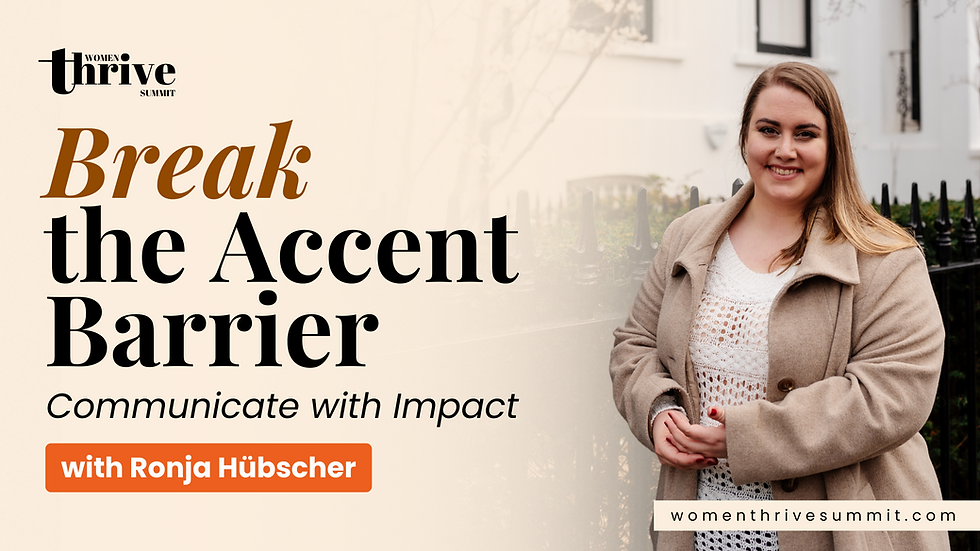
I’ve been nominated for Best Positive Impact Speaker AND Speaker of the Year at the Women Thrive Summit 2025—and your vote could help this story reach even more people.
👉 Click here to vote (it takes 1 minute, email required but no newsletter opt-in needed!) - you'll find my name in the second category under 'Best Positive Speaker' and at the end when you can enter my name for 'Speaker of the Year'.
Thank you for being part of this journey. Let’s keep breaking the accent barrier—together.
VOTE HERE - voting ends soon!!
LAST CHANCE to catch the replay of my talk for FREE - head to https://womenthrive.link/ronjahuebscher
and don't forget to vote afterward!